
The science, explained: Standardisation
Why does every learner take it the same way?
Tiring markers drift: after a long morning, the same work gets lower marks. A score shouldn't depend on who set up or marked the assessment.
The short answer
Standardisation
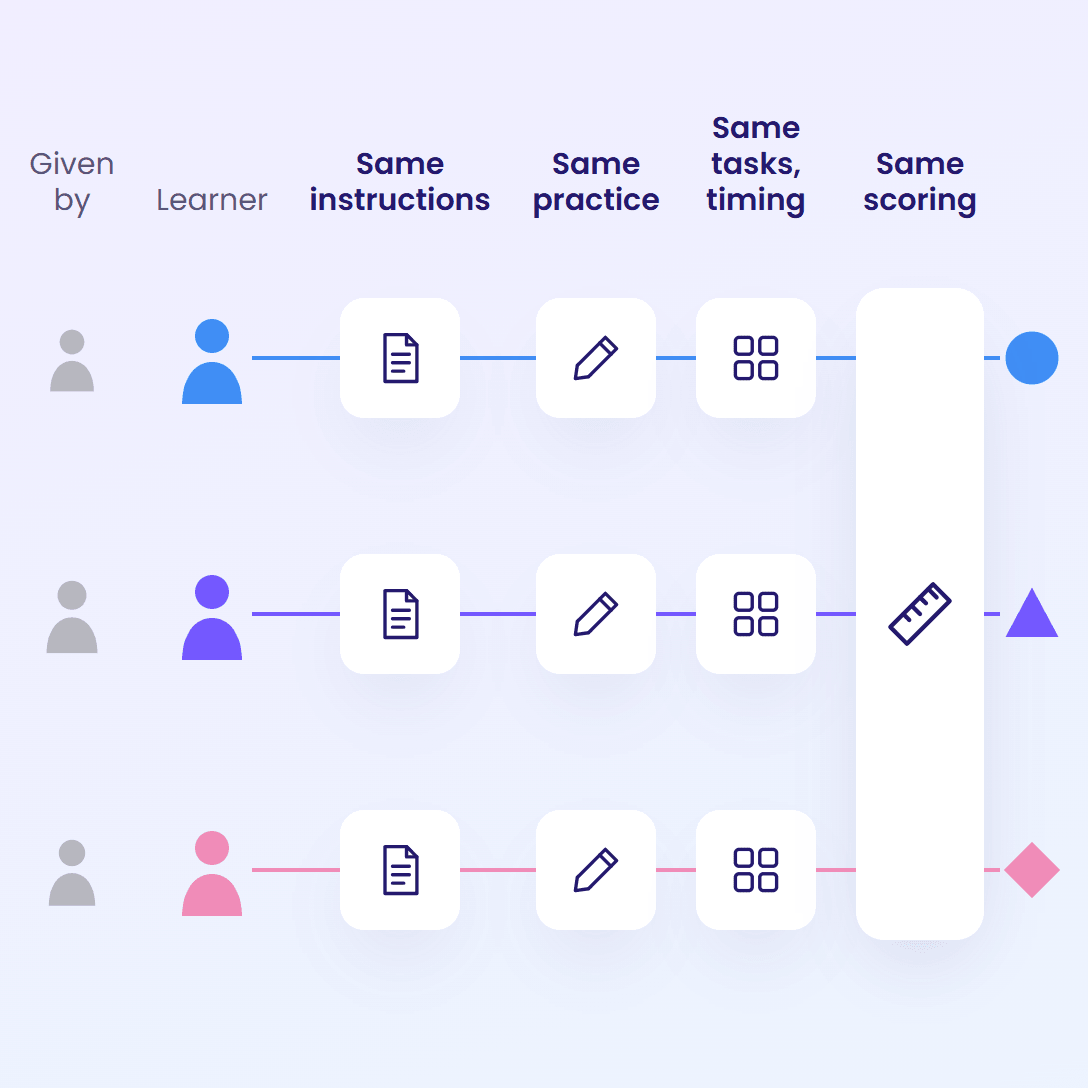
Standardisation means every learner gets the same instructions, the same practice, the same tasks and timing, and the same scoring, so a difference in score comes from the learner, not from who gave the assessment or who marked it. A fixed scoring rule is the marker who never tires.
You already do this when you moderate
Moderation exists so a mark means the same whoever gave it, and whenever. Answers vary too: two tutors asking the same learner "how are you finding it?" will hear two different answers. Those conversations matter, and they stay: they're how you get to know a learner. When a score helps decide who gets support, the fairness has to be built in, so the only thing that changes is the learner.
What the science calls it
Three terms you may see in a report
The tiring marker and moderation have already shown you the idea. These are the names the science gives to it.
- Standardisation
- Every learner takes the assessment the same way, so their scores can be compared fairly.
- Standardised administration and scoring
- The same instructions, practice, tasks and timing for everyone (the administration), and the same rule turning answers into a score (the scoring).
- Inter-rater reliability
- Whether two people marking the same work give it the same mark. When a fixed rule does the scoring, there's only one marker.
If the learner took it again, would they get a similar score?
Why it matters before you compare or act on a score
Scores you can compare. Learners at different campuses, set up by different staff or teams, got the same instructions, the same practice, the same tasks and the same scoring, so their scores can be read side by side.
Ask any assessment, ours included. Does every learner get the same instructions and practice, and is every answer scored the same way, whoever sets it up? It's a fair question to put to any assessment before you choose one.
Something steady for your judgement. Standardisation doesn't replace what you know about a learner. It gives your judgement a steady starting point: a score starts the conversation, and your judgement decides what support comes next.
How our assessment does it
Every learner gets the same instructions, the same practice and the same scoring
Before each task, every learner sees the same plain-language instructions on screen, can hear them read aloud, and answers a practice question before anything counts. Then come the same tasks, each timed, with questions in the same order of difficulty and the same rule for when a task ends. Learners take it on their own, in a desktop browser, in one sitting.
- Scoring is fully automated and identical for every learner: no marker, no tired afternoon, and the same answers always earn the same score.
- The room is the part it can't set, so it asks for a quiet, undisturbed place. Engagement checks, one in each of the nine areas measured, set aside any score affected by an interruption.
- It's built to the International Test Commission's (ITC) guidelines for technology-based assessment, and Cognassist is an ITC affiliate member.
Questions tutors ask
Learners are all different. Isn't treating them the same unfair?
The process is the same so that the differences you see are the learner's own, not down to who gave the assessment or who marked it. What you do with the result is individual: the conversation you have with the learner, and the support plan you agree with them.
What if the room was noisy or the learner was interrupted?
The assessment asks each learner for a quiet place where they won't be disturbed, and engagement checks set aside the affected score if a learner was interrupted or clicking through. If a learner was clearly disrupted, an administrator at your organisation can reset the assessment so they can take it again. And a score is never the only basis for a decision: your judgement decides.
Does it matter which member of staff sets it up?
No. Learners take it on their own, with the same on-screen instructions, and the scoring is automatic, so the result doesn't change with who sends the invitation or who is in the room. It's designed for tutors and operational staff to run, not specialist assessors.
Is this the same as a standardised score?
Related, but not the same. A standardised score places a learner against people of the same age, which is its own question. Standardisation is taking the assessment and scoring it the same way for everyone, and that's what makes the comparison fair.