
For apprenticeship and adult skills providers
Learning support funding decisions that stand up when a claim is reviewed
Record support decisions as they happen, keeping additional support apart from everyday teaching. Claim with confidence, or fund the extra support you already deliver, safely.

What the rules ask
What a learning support claim has to show
Keeping support notes is right, but a claim is tested on the decision behind it. When a DfE funding assurance review finds a funding error in its sample, the provider must self-audit every learner who could share that error, and DfE recovers any funding overclaimed, including from prior years. Many providers under-claim learning support funding: eligible learners go unidentified, and delivered support goes unclaimed when the evidence is patchy.
- Why this learner needs this support on this programme, and how their progress would be affected without it
- A plan for the support, agreed with the learner
- The additional support delivered each month, which must cost money: support that costs nothing, or is part of everyday teaching, cannot be claimed
- Regular reviews confirming the support is still needed and working
A claim can run only from the date the evidence exists, so finding learners' needs at the start of the programme matters.
Proof · Brighter Horizons
Good records first, a funding position they can defend
Brighter Horizons, an independent training provider, set out to raise the standard of its additional learning support. With records the team trusts, it reached a confident, compliant funding position, and now claims funding it had previously missed out on.
“Cognassist has been instrumental in helping us put strong policies and strategies in place. We now feel completely confident in our evidence and compliance.”
- 100%learning support funding claim compliance
- 15%of apprentices receiving support funding, up from 5%
The golden thread
One line from each learner's need to every month of support claimed
Each step is the everyday work of supporting a learner, linked to the next and recorded as it happens, so a funding review can trace any month of support back to the need that justified it. The platform keeps the links; your staff make the judgements.
Assessed need
The cognitive assessment flags a potential barrier: a signal for tutor judgement, never a diagnosis, and never the only basis for the decision.
Matched reasonable adjustment
The barrier is matched to a reasonable adjustment, written for the learner's course, that carries its intent: the barrier it is there to address.
Support plan
The tutor sets out in the support plan why this learner needs it on this programme, and what happens without it; the learner agrees it.
Additional support delivered
Each month the tutor selects the adjustment they supported, confirms it was delivered and marks whether it was additional to everyday teaching.
Monthly record
The tutor notes the impact; the selected adjustment brings its intent, so the record holds intent, implementation and impact: what was done, what changed.
Review
The impact recorded each month is what a review reads to confirm the support is still needed and working.
Recorded as it happens
Additional support recorded apart from everyday teaching, as it is given
When a tutor records support, they select the adjustment they supported, confirm it was delivered, note the impact and say if it was additional to everyday teaching, with the meeting type, date and hours. The why travels with the adjustment, so nobody rewrites it monthly. Evidence is captured at the point of delivery, not built retrospectively, and each record is checked against intent, implementation and impact as it is written.
- Everyday and additional support kept apart, so what may be claimed is never mixed with everyday teaching
- Each record checked as it is written, so gaps show while there is still time to close them
- The evidence exported when you need it: per-record PDFs that state whether the support was additional, bulk evidence CSVs and the API, for your own Individualised Learner Record (ILR) return
Your eligibility, your ILR coding, your claim: Cognassist supplies the evidence.
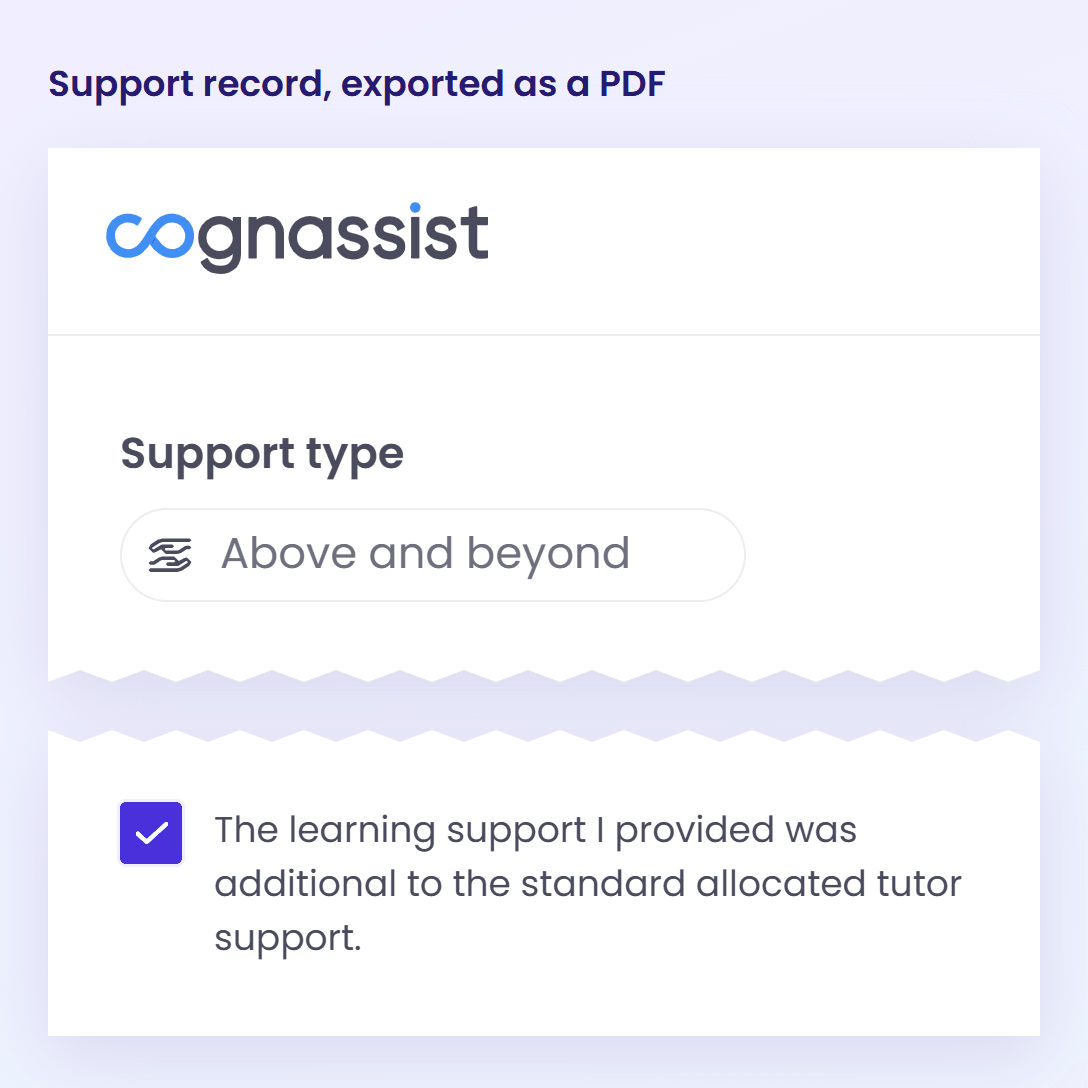
One support record, exported: it says the support was additional to everyday teaching.
What funding and support teams say
A university claiming for its degree apprentices, and two support teams on the records a claim rests on.
They are claiming support funding for apprentices identified as needing additional support from the start ... Cognassist is critical for us in this process, alongside other tools.
The coverage checker provides clear guidance on language and structure ... ensuring our notes include the right level of detail and link back to the supporting evidence.
Workload-wise, it's much smoother. I no longer have to search for information. I can simply attach the learning support plan and Cognassist assessment, and everything is clear and ready to go.
FAQ
Questions
Is recording support this way worth it if we never claim?
Yes. Records of why each learner needs support, and what changed, are evidence of good practice whatever you decide about funding. Keeping everyday teaching apart from additional, costed support shows you exactly what you deliver beyond it. And if you decide to claim, the evidence already exists from the day each record was made.What can and can't be claimed?
Learning support funding pays for reasonable adjustments that cost money and are additional to everyday teaching, delivered and evidenced month by month. It does not pay for adjustments that cost nothing, help unconnected with the apprenticeship, gaps in learning with no learning difficulty or disability behind them, or adjustments in the workplace, which employers provide. Our guide sets out the full list.What makes a support record stand up when a claim is reviewed?
It traces back to the assessed need and the reasons for the support, sits in a plan agreed with the learner, records the additional support delivered each month and its impact, and shows the support was reviewed. And it was recorded at the time, not rebuilt before a review. That is what makes a record audit-grade.Does the cognitive assessment decide who is eligible?
No. You decide, from a thorough, evidence-based assessment of the learner, and the rules say not to rely on an automated assessment alone. The cognitive assessment is one robust part of that evidence and a signal for tutor judgement. It is not a diagnosis, and it does not by itself establish disability under the Equality Act 2010.Does Cognassist claim funding for us, or guarantee a claim?
No. Your eligibility, your ILR coding, your claim and your quality policy all stay yours. Cognassist supplies the evidence: each record's intent, implementation and impact, whether the support was additional to everyday teaching, and the meeting type, date and hours, exportable whenever you need it.Do we get an ILR reconciliation report?
No, that report is not built. You can export per-record PDFs, which state whether the support was additional, bulk evidence CSVs and the data through the API, and map them to your own ILR return.Does this work for training providers, colleges and universities?
Yes, wherever learning support funding is claimed: by apprenticeship and adult skills providers, including college and university apprenticeship teams. Degree apprentices cannot get the Disabled Students' Allowance, so their support follows the same apprenticeship rules. Colleges' Inclusive Mainstream Fund for learners aged 16 to 19 is separate: a whole-setting grant with no per-learner claim, covered on its own page on our site.
Where to go next
See how each support record is checked
Each record is checked against intent, implementation and impact as it is written, so gaps close in time.
Read the rules and the evidence pack
What a learning support claim must hold, line by line: eligibility, the evidence pack and reviews.
See how Brighter Horizons claims with confidence
An independent training provider with full claim compliance and more apprentices receiving support funding.
Find the needs first
Claims run from when the evidence exists, so see how providers find learners' needs at the start.
Turn good records into a position you can defend
Book a demo built around your provision, and see how each support decision would be recorded as it happens, with additional support kept apart from everyday teaching, whether you claim today or want to start safely.