
For universities with degree apprentices
Find the apprentices who need support at induction, in every university faculty
A cognitive assessment at induction, beside what apprentices disclose, gives every faculty one starting point, so support starts well before gateway.

Trusted by universities that run degree apprenticeships, including




Apprenticeships in a university
Finding apprentices' needs early, across a university
You already find need: apprentices disclose, you screen at induction as the rules ask, academic mentors get to know them, and wellbeing and specialist staff support those referred. Each stays. Each depends on what an apprentice knows about themselves, or waits until a need shows.
Many faculties, one standard
- Apprentices in business, engineering or health each start in a faculty with its own habits, so how early a need is found can depend on where they study.
- Ofsted inspects your apprenticeship provision and grades inclusion in its own right, asking how staff identify apprentices' needs early.
The apprenticeship rules, not the DSA
- Degree and higher apprentices cannot get the Disabled Students' Allowance (DSA). Their support follows the apprenticeship learning support rules, as every apprenticeship's does.
- Those rules ask for a screening exercise at the start, the one you already run, and a further evidence-based assessment where it points to a need.
- Where support is funded through learning support, the rules ask for a plan the apprentice agrees in writing, evidence of the support delivered, and a review at least every three months.
Needs found late cost time
- A need that surfaces mid-programme, through a disclosure or a struggle, leaves less time to support it before gateway, and on-time achievement is at risk.
- The gap shows nationally. In 2024/25, apprentices with a declared learning difficulty or disability achieved at 62.3%, against 65.9% for those without.
A university like yours · University of Exeter
Ofsted found the University of Exeter identifies apprentices' needs quickly and accurately
In its May 2026 inspection, Ofsted found: "Staff identify apprentices' learning and support needs quickly and accurately through structured assessment, effective disclosure opportunities, ongoing review and close collaboration between academic mentors, wellbeing teams and specialist staff." In Exeter's own account, apprentices take the cognitive assessment at induction, not as a gateway, as provision grew from 16 apprentices in 2016 to 3,800.
“Cognassist helps us understand early on what their starting point and support needs are, so we can track learners and improve achievement rates”
- Strong standardInclusion, graded by Ofsted in 2026
- ExceptionalAchievement within apprenticeships, graded by Ofsted in 2026
- 80%+Apprenticeship achievement rate, above the national average
How it works
Find need at induction, the same way in every faculty
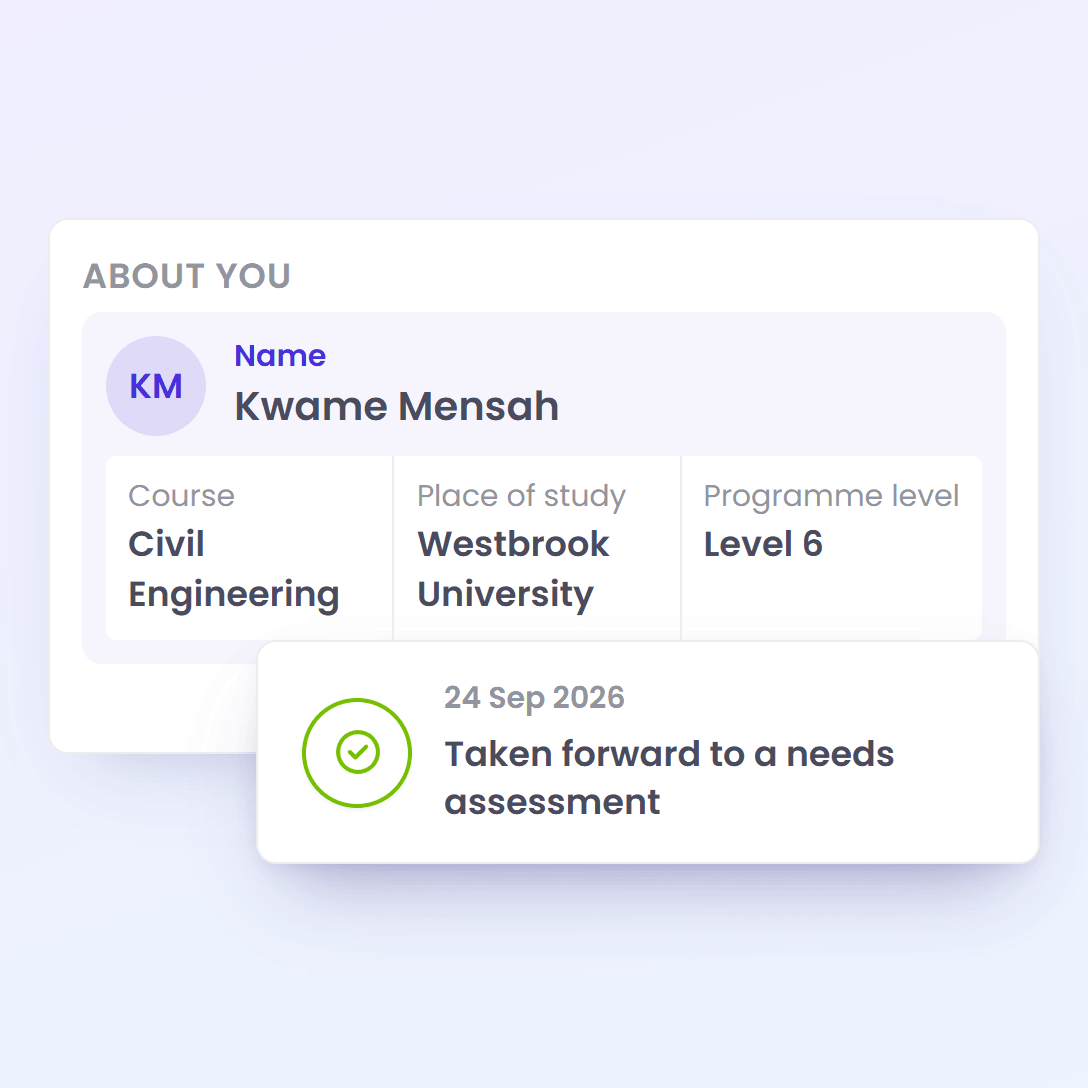
Disclosure and your screening at induction tell you how an apprentice sees their own learning, and both stay. The cognitive assessment adds how they actually process, remember and reason. Each apprentice takes it at induction, in approximately 30 to 40 minutes, beside what they disclose, the screening and any prior records, replacing none of them. It is not a gateway, so no apprentice is judged before they start.
- The same starting point for every apprentice, whichever faculty they join, so you can show inspectors one way of working across the university
- The academic mentor opens the needs conversation with the apprentice, and the result is a signal for the mentor's judgement, never a diagnosis
- A personalised support plan is generated in approximately 10 minutes, for the tutor to tailor. The academic mentor and the apprentice then agree it together.
The evidence
Every adjustment recorded with the need it answers
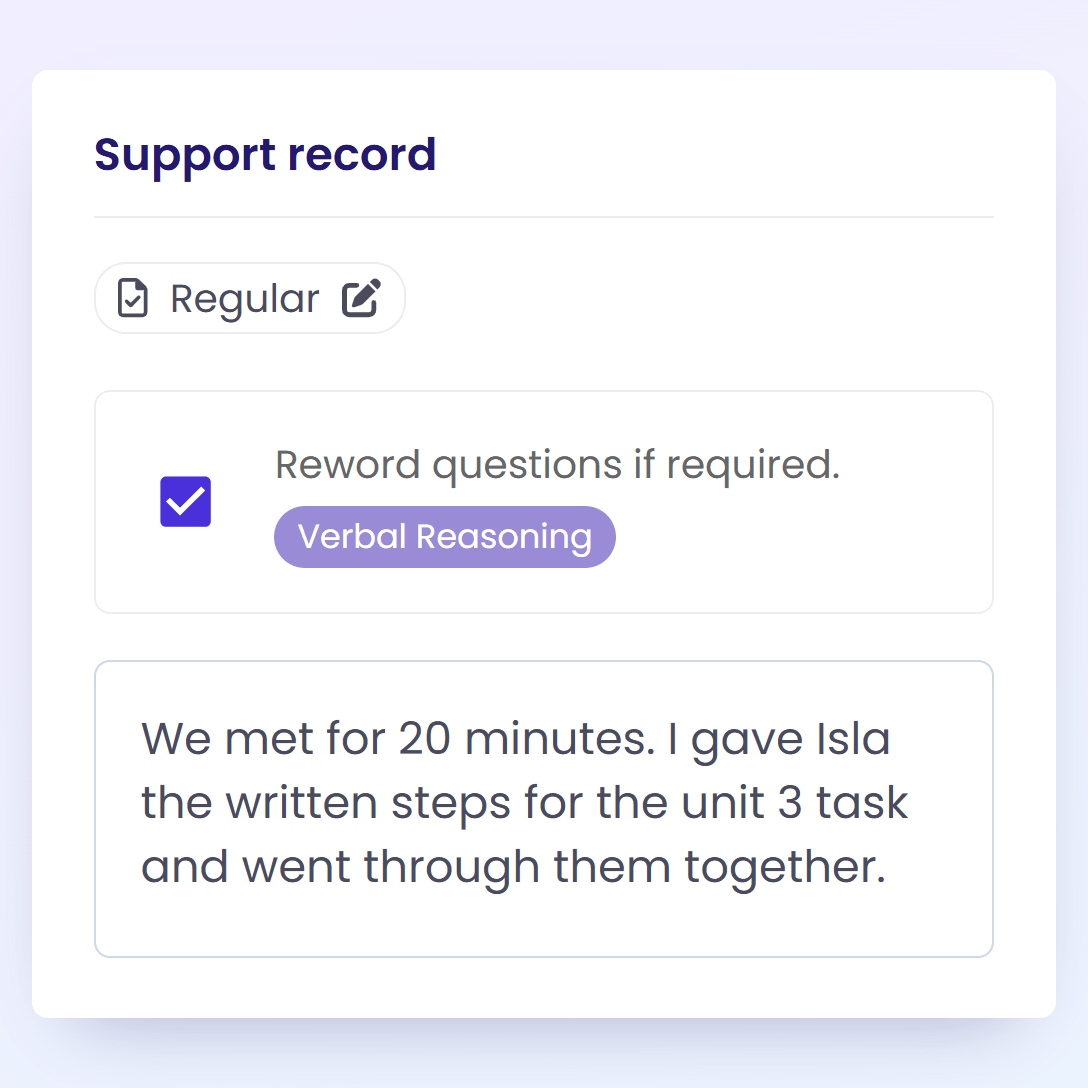
The support record captures each adjustment, the need it answers and its evidence at the point of delivery, never rebuilt afterwards. It keeps everyday inclusive practice, the adjustments that cost nothing, like extra time on an assignment, separate from additional costed support. Your staff make the judgement; the record keeps it. When an inspector, a funding review or a complaint asks, good records show good practice.
- As each entry is saved, the record checks it covers the need, the adjustment and its impact, so a gap is fixed while the support is fresh
- The same documented adjustments carry to end-point assessment, accepted by most awarding organisations
See how the evidence supports exam access at end-point assessment
Where to go next
Identify learners' needs
Find which apprentices need support at the start, and what would help each one.
Exam access evidence for end-point assessment
Standardised evidence for extra time at end-point assessment, found at induction rather than at gateway.
Support apprentices consistently once needs are found
The same quality of support across tutors, mentors and faculties, once you know who needs it.
How the University of Exeter does it
How one university made the cognitive assessment part of induction, without making it a gateway.
FAQ
Questions
What software helps universities identify at-risk apprentices?
A cognitive assessment at induction, taken beside disclosure and prior records, shows which apprentices may need support early enough to act, in every faculty. The academic mentor and the apprentice then agree what would help. Cognassist provides that assessment, and in our validation research the cognitive profile predicted withdrawal better than a diagnosis label. The University of Exeter uses it at induction for its apprentices.Can degree and higher apprentices get the Disabled Students' Allowance?
No. Their support follows the apprenticeship learning support rules, which apply to every apprenticeship in England: a screening exercise at the start, a further evidence-based assessment where it points to a need and, where support is funded through learning support, a plan the apprentice agrees in writing and evidence of the support delivered. The assessment at induction starts that work, and the support record keeps the plan and evidence.We already screen apprentices at induction. Why add a cognitive assessment?
Keep it: the rules ask for it. Asking a learner tells you how they see their own learning; measuring tells you how they actually process, remember and reason. The assessment shows which apprentices may need support, even when they did not know to say. Professor Sarah Tudor, University of Exeter: "Unless someone self-discloses or has a pre-existing diagnosis, these are the main tools we use to identify support needs."We already run a learning platform, a student records system and an e-portfolio. What does Cognassist add?
It works alongside your systems, never instead of them. Partner-built connectors link it to the e-portfolio and delivery platforms apprenticeship teams use (OneFile, Bud, Aptem and OneAdvanced ePortfolio), and a public application programming interface (API) is there for anything else. It adds the cognitive assessment, the support plan, the support record and leadership oversight. We show how it fits your setup in a personalised demo.Is the cognitive assessment a diagnosis?
No. The assessment measures the cognitive differences associated with specific learning differences to inform professional judgement. It is not a clinical diagnosis, and it does not by itself establish disability under the Equality Act 2010.Does it help apprentices at end-point assessment?
Yes. The same documented adjustments carry to end-point assessment, accepted by most awarding organisations. Formal exam access arrangements also need a qualified assessor. Our exam access arrangements page has the detail.Does it replace our academic mentors, wellbeing staff or disability service?
No. It gives academic mentors and tutors a consistent start with each apprentice, so your wellbeing and specialist staff and your disability service spend their time on the apprentices who need them most. Who gets which support stays your call.
Know your apprentices' needs from induction, in every faculty
See it working for a provision like yours. The demo is built around your faculties, your systems and where you want to get to.