
Cognitive domains
What the Cognassist cognitive assessment actually measures
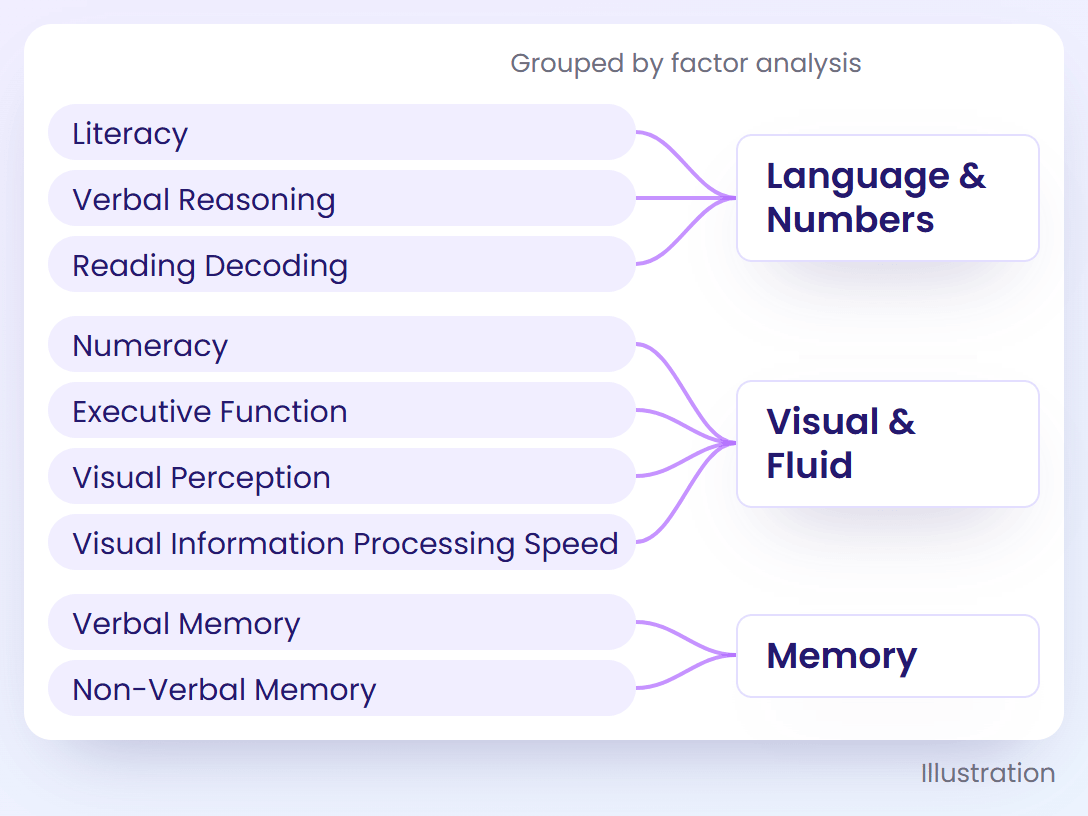
Nine cognitive domains in three indexes, read in two steps: the index scores say whether support may be needed; the domain scores say what kind.

What it measures
Nine cognitive domains, across three cognitive indexes
The assessment measures each domain separately, through its own tasks, and every score is age-adjusted. The definitions below are the words a learner and tutor see on the report, grouped by the index each domain belongs to.
Language & Numbers
3- Literacy: the ability to read and understand written information. It helps someone make sense of what they're reading and link it to what they already know.
- Verbal Reasoning: the ability to understand and work with words and language. It helps someone solve problems, follow instructions, and express ideas clearly.
- Reading Decoding: the ability to recognise written words and turn them into sounds. It's what helps someone read new or unfamiliar words by sounding them out accurately and fluently.
Visual & Fluid
4- Numeracy: the ability to understand and work with numbers. It helps someone make calculations, spot patterns, and apply maths to everyday tasks. Numeracy belongs to Language & Numbers too, and is shown once, here.
- Executive Function: the ability to plan, organise, and manage tasks. It helps someone stay focused, switch between activities, and keep track of what needs to be done.
- Visual Perception: the ability to make sense of what someone sees. It helps them notice shapes, patterns, and differences in things like charts, signs, or diagrams.
- Visual Information Processing Speed: the ability to quickly understand and respond to visual information. It helps someone take in what they see and react efficiently.
Memory
2- Verbal Memory: the ability to remember spoken or written information. It helps someone recall words, instructions, or facts they've read or heard.
- Non-Verbal Memory: the ability to remember images, patterns, and locations. It helps someone remember how to do something or where they've seen something before.
Three indexes: read them first, then the domains
An index score pools the scores of several related domains into one, so it leans on no single task. The cognitive assessment gives three (Language & Numbers, Visual & Fluid, and Memory): the index scores say whether support may be needed; the domain scores say what kind.
- Read the indexes first, for the broad picture of where a learner's profile sits. Then read the domains beneath each one, for where to focus.
- Speed of Working is reported on its own, apart from the three indexes.
From whether to what kind: one index, then its domains
This is going to be brilliant. The new report is incredibly useful with some excellent insights into a person's cognitive profile that will help me to carry on tailoring support to each individual and their strengths
On the index and domain scores, when they were introduced on the platform.
Why these nine, and not some other set
The assessment is performance-based, so it measures how a learner thinks and learns, not what they already know. The set is not arbitrary, and you can say exactly why.
- Grounded in the Cattell-Horn-Carroll (CHC) model, the internationally recognised taxonomy of cognitive ability, with the Baddeley-Hitch model as a complementary anchor for working memory.
- The three indexes come from the assessment's own data, not from an assumption: factor analysis of the assessment data finds three groups, and those groups become the three indexes.
- Each domain picks up something the others do not: tasks that measure related things go together more than tasks that measure unrelated ones.
- Together they cover a wide spectrum of the cognition that matters for learning: broad, not a complete map of all human cognition, and not the depth of a formal diagnosis.
The Cognassist cognitive assessment has been independently validated as accurate and robust.
It became a battle. The specific gap the EPAO pointed to was processing speed. There were no numbers, no testing. They couldn't see how we could validate that a learner needed extra time.
Aspiration Training, an independent training provider, replaced the self-report assessment its end-point assessment organisations were rejecting as evidence with the cognitive assessment. It embedded it at enrolment, alongside maths and English. Read how Aspiration Training replaced an assessment its EPAOs rejected
FAQ
Questions about what the assessment measures
What are the nine cognitive domains Cognassist measures?
Cognassist measures nine cognitive domains, grouped under three cognitive indexes. Language & Numbers: Literacy, Verbal Reasoning and Reading Decoding. Visual & Fluid: Numeracy, Executive Function, Visual Perception and Visual Information Processing Speed. Memory: Verbal Memory and Non-Verbal Memory. Numeracy belongs to Language & Numbers too, and is shown once, under Visual & Fluid. Nine domains across three indexes.What are the three cognitive indexes?
Language & Numbers, Visual & Fluid, and Memory. The index scores say whether support may be needed; the domain scores say what kind. Read the indexes first for the broad picture, then the domains beneath each for where a learner's profile takes shape.What does the Cognassist cognitive assessment measure?
It measures how a learner thinks and learns, not what they already know. The assessment is performance-based, takes approximately 30 to 40 minutes, and produces a cognitive profile across the nine domains and three indexes. To see it in practice, visit the cognitive assessment page; for the evidence behind it, see the science page.What does a score of 84 or below mean?
A standardised score of 84 or less is considered to be in the below average range. When an index scores 84 or below, the results suggest a needs assessment conversation between tutor and learner; when only a domain does, they suggest reviewing the results with the learner. Both are signals for the tutor's judgement, never verdicts. The page on what a score of 84 means explains the line.Why nine cognitive domains?
Because the set is grounded in the Cattell-Horn-Carroll model and the three-index structure is empirically derived through factor analysis, not assumed. Each domain measures a distinct ability. Together the nine cover a wide spectrum of the cognition that matters for learning, broad rather than a complete map of all human cognition.Where does Speed of Working fit?
Speed of Working is a separate result, reported apart from the three indexes. It gives standardised evidence when extra time is being considered, and it is recognised by most awarding organisations. For formal exam access arrangements, a suitably qualified assessor must be present to oversee the assessment. The page on exam access arrangements evidence explains how providers use it.Is a domain result a diagnosis?
No. A domain or index result is a signal to inform a professional's judgement, never a diagnosis or a verdict. It does not by itself establish disability under the Equality Act 2010. It is never the only basis for a support decision.What is a cognitive assessment?
An assessment of how a person takes in, holds, works with and stores information, measured through tasks rather than questions about themselves. For what ours involves and what a tutor sees afterwards, see the cognitive assessment page.
Keep exploring
The cognitive assessment
How learners take the assessment, and what a tutor sees afterwards.
What a score of 84 means
How a domain or index score is read, and what the line on the results tells a tutor.
Exam access arrangements evidence
How the Speed of Working result becomes standardised evidence when extra time is being considered.
Glossary: the science in plain words
The terms behind cognition and cognitive assessment in a line or two, each with a link to the page that explains it.
See the nine domains and three indexes in a real learner's results
A demo built around your setup and where you want your provision to get to. You'll see a learner's index and domain scores, and how a tutor reads them to plan support.