
For providers whose learners sit exams and end-point assessment
Standardised evidence for exam access arrangements
Find who needs extra time at enrolment, not at gateway: a standardised measure of how quickly they work, and documented adjustments most awarding organisations accept.

The problem
Extra time needs evidence, and the need often surfaces too late to gather it
What learners tell you, and a specialist's assessment where one is needed, stay right. But for many learners, the first formal request for an adjustment comes at qualification or end-point assessment, with little time left to evidence it. An awarding organisation or end-point assessment organisation (EPAO) deciding extra time looks for a standardised measure of how quickly the learner works. Self-report and a tutor's observation do not give one.
Measured at enrolment, the need for extra time is known long before gateway or exam entry, so the adjustment is already in place, and documented as the learner's normal way of working.
Customer story · Aspiration Training
An EPAO rejected their self-report evidence. Aspiration Training replaced it with a standardised assessment at enrolment.
Aspiration Training, an independent apprenticeship training provider, used a self-report assessment that end-point assessment organisations were rejecting as invalid evidence. It replaced it with a validated cognitive assessment, which measures processing speed on standardised scores, and embedded it in enrolment alongside maths and English.
“It became a battle. The specific gap the EPAO pointed to was processing speed. There were no numbers, no testing. They couldn't see how we could validate that a learner needed extra time.”
- 20%Uplift in learners receiving personalised support, in two months
- Expected standardAcross every Ofsted area, May 2026
How it works
Standardised evidence of how quickly a learner works, and the adjustments that follow
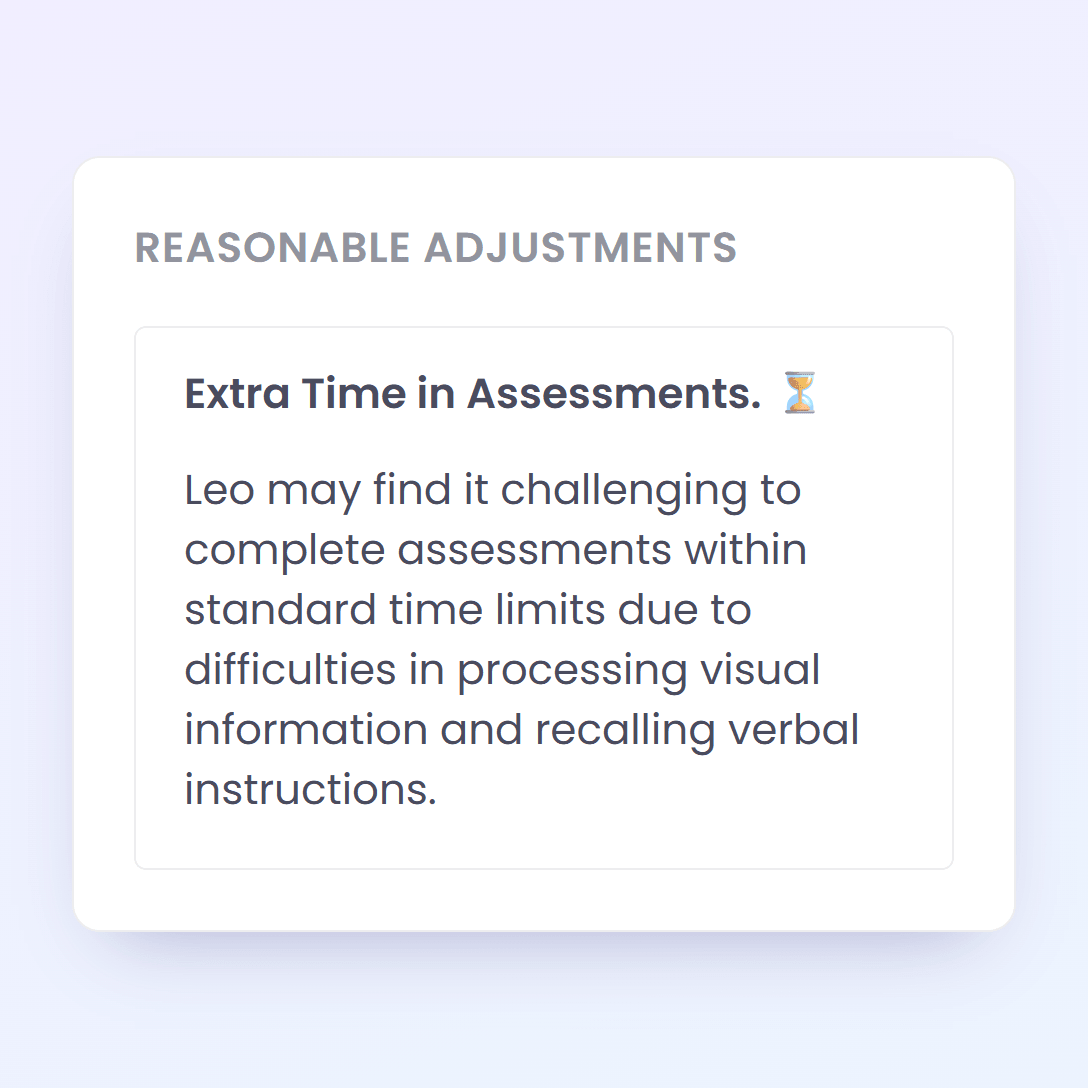
The cognitive assessment includes a Speed of Working result: how quickly a learner works, on standardised scores against population norms. Assess at enrolment and you know it from the start. A result below the typical range (84 or below), or significantly slower than their own other areas, is standardised evidence toward additional time. Their support plan then puts extra time first, documented as their normal way of working.
- Most awarding organisations and end-point assessment organisations accept the Speed of Working result and the reasonable adjustments documented in the support plan. The awarding organisation decides any arrangement.
- The line at 84 follows the Joint Council for Qualifications (JCQ) access arrangements regulations, which treat a standardised score of 84 or below as below average.
- The assessment is reviewed by PATOSS against JCQ's scientific validity requirements.
- For formal JCQ exam access (Form 8), the result counts as Part 2 evidence when a qualified access arrangements assessor is present to oversee the assessment and observe the learner.
What our customers say
An arrangement approved, requests accepted by awarding bodies, and evidence for extra time in exams.
Her Cognassist report helped us to really strengthen the approval of 50% additional time, and she then passed straight away after that.
Here at YMCA we utilise the Cognassist report for applications of additional time in end-point assessment settings, where required. To date we’ve used multiple awarding bodies ... and all have accepted the requests.
When learners do an assessment, we can use that evidence to allow for extra time in exams.
The honest boundary
A recognised first step that targets specialist time, not a replacement for the specialist
Read it in order: what your centre applies directly, what the result evidences, and where a qualified assessor is needed.
What your centre can apply directly
- Some adjustments, such as overlays, rest breaks or prompts, are centre-delegated: the centre can apply them directly, with no formal assessment route.
What the Speed of Working result evidences
- Standardised evidence of a learner's normal way of working toward additional time, with the adjustments documented in their support plan, accepted by most awarding organisations.
- Where you assess learners at enrolment, it shows early who is likely to need formal arrangements, so a qualified assessor's time goes to them. A signal for your judgement, not a diagnosis.
Where a qualified assessor is needed
- For formal JCQ exam access, Form 8 Part 2 is completed by a qualified access arrangements assessor, such as a Level 7 specialist assessor, an SpLD Assessment Practising Certificate holder or an HCPC-registered psychologist.
- That assessor either supervises our assessment, present to oversee it and observe the learner, or carries out their own. Our result is evidence toward the case, never the completed Form 8.
FAQ
Questions
Who puts the application to the awarding organisation?
You do, through the awarding organisation's or end-point assessment organisation's own access arrangements process. The cognitive assessment and the support plan give you the evidence of the learner's documented normal way of working, including the adjustments already in place. The awarding organisation makes the final decision on any arrangement; the evidence supports the case you put to them.Is the Cognassist assessment a completed Form 8, or does it replace the specialist assessor?
No, and we would not claim it is. For formal JCQ exam access, Form 8 Part 2 is completed by a qualified access arrangements assessor. Our result counts as Part 2 evidence when that assessor is present to oversee the assessment and observe the learner, or the assessor carries out their own. Cognassist is evidence toward the case, and shows early who is likely to need the formal route.Is the assessment a diagnosis?
No. It measures the cognitive differences associated with specific learning differences and is a signal for professional judgement, not a diagnosis. A below-average Speed of Working result reflects slower processing speed as a characteristic of how a learner works; it does not by itself establish disability under the Equality Act 2010.Do we need a specialist to run the assessment?
Not to run it. Tutors and operational staff do: the workflow is designed for non-specialist delivery, and the platform structures and records the judgement while your staff make it. The exception is formal JCQ exam access (Form 8), where a qualified assessor must be present to oversee the assessment and observe the learner. Where you assess learners at enrolment, it surfaces early who may need arrangements.Does this work for apprenticeships, further education and degree apprenticeships?
Yes, wherever an awarding organisation or end-point assessment organisation decides an arrangement, for a qualification exam or an end-point assessment: at training providers, colleges and universities' apprenticeship teams, including degree apprentices' end-point assessment.
Where to go next

See the cognitive assessment
Where the Speed of Working result comes from, and what else it measures.

What a score of 84 means
What a below-average score is, and why the exam boards draw the line at 84.

What makes a cognitive assessment worth trusting
The questions to ask of any assessment before its results are used as evidence.

How Aspiration Training changed its evidence
An EPAO rejected its self-report evidence. What the provider changed at enrolment, and what followed.
Book a demo and see the evidence for yourself
A demo built around your provision, showing how a learner's speed of working is measured at enrolment and the extra time it leads to is documented in their support plan, ready for the awarding organisation.