
For colleges and training providers
Ofsted inclusion readiness starts with how you identify learners' needs
Inspectors ask how staff identify learners who need support, even when you report none. Find needs early, meet them consistently, and show what support changed.
What inspectors ask
How do your staff identify learners who need support?
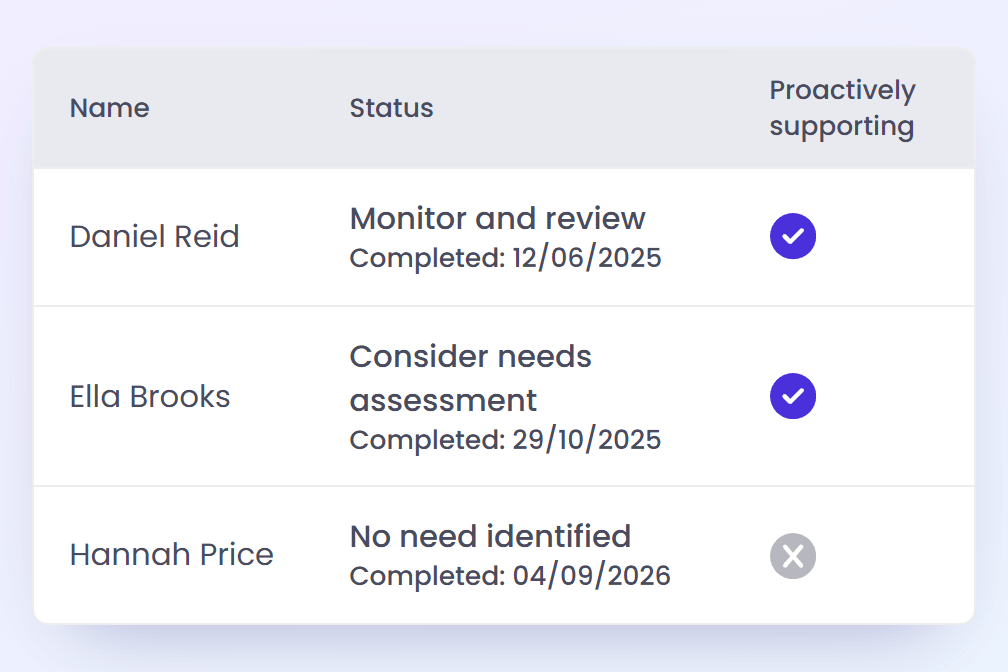
Inspectors explore how your staff are able to identify learners who need support, "even if leaders have not identified any" (Ofsted's operating guide, September 2026). At the expected standard, leaders and staff "quickly and accurately identify" learners' needs. What you do today stays: what learners tell you, screening, prior records and plans, staff noticing. Each finds what someone already knows. Measuring at the start adds what no one has spotted.
228 of this year's 529 Ofsted reports on further education (FE) and skills providers, published from 12 January to 13 November 2026, praise needs being identified early and accurately; 16 record needs found late, or only when a learner declared them.
Case study · Educationwise
Ofsted graded Educationwise's inclusion Strong standard, from finding needs to achievement
In July 2026, Ofsted graded Educationwise's inclusion Strong standard. Inspectors found "comprehensive and rigorous processes to assess swiftly the support that apprentices and adult learners need", staff who review "the support they provide critically and adjust this over time to ensure that it remains impactful or can be removed", and "nearly all apprentices who have an identified barrier to learning and remain on their programme achieve their qualification".
“Cognassist forms part of a wider inclusion process: identifying potential barriers, discussing them with the learner, agreeing support and checking whether it helps.”

- Strong standardInclusion graded by Ofsted, July 2026
- 91%of disadvantaged apprentices who completed their end-point assessment in 2025/26 passed
- Allof those disadvantaged apprentices went on to a positive destination
The golden thread
One line from each learner's assessed need to its impact
Each step is the everyday work of identifying and supporting a learner, not a document for inspection. As Ofsted's toolkit puts it: "We do not need leaders to produce documents specifically for an Ofsted inspection". The platform links and records each step; your staff make the judgements.
Assessed need
The cognitive assessment at the start flags a potential barrier, beside what the learner and staff know: a signal for tutor judgement, not a diagnosis.
Matched reasonable adjustment
A recommended adjustment is linked to that need, carrying its Intent: what it is meant to change.
Support plan
The adjustment goes into the learner's support plan, agreed with them.
Delivery
Support is delivered as part of everyday teaching and coaching.
Monthly support record
Each month the tutor records the support against intent, implementation and impact, and real-time coaching checks the record as it is written.
Leadership oversight
Leaders see support land across the whole provider in an admin-only view, and act on gaps before they become findings.
Leadership oversight
See how consistently needs are found and met, across the whole provider
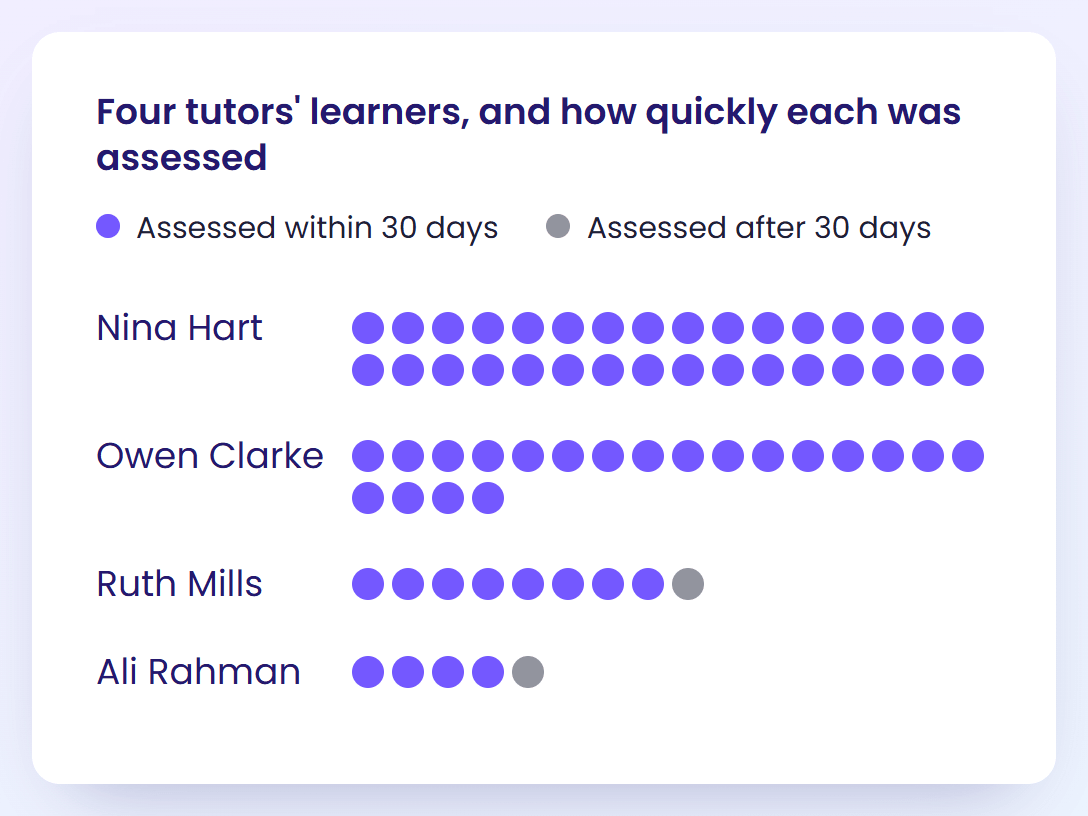
An admin-only view across the whole provider, for leaders, not tutors. See how learners move from assessed to identified to newly supported, down to each tutor; how promptly each tutor moves learners on; record quality month by month; and the share moved off support, so leadership can demonstrate active oversight to Ofsted and act before gaps become findings.
- Consistency across tutors: the per-tutor view shows where practice differs. Ofsted's toolkit lists "weaknesses or inconsistencies in providing support" that harm a particular group among the signs of needs attention.
- Good use of data: at the strong standard, leaders "make good use of data to understand the needs of their learners". This view puts that data in front of them, from assessment to support.
- Support stepped down: see the share of learners moved off support. At the strong standard, "Leaders consistently identify when additional learning support is no longer required or can be reduced".
Results
Learners with needs achieving, in inspectors' and customers' words
What this year's Ofsted reports record, what inspectors found at Aspiration Training, and what the University of Exeter says.
As a result of this support, the achievement rate of apprentices with barriers to their learning has substantially increased and is in line with their peers.
Cognassist helps us understand early on what their starting point and support needs are, so we can track learners and improve achievement rates.
Where to go next
See leadership oversight across your provider
An admin-only view of who is identified, supported and moved off support, and how consistently each tutor does it.
Find the needs first
Measure at the start, alongside what learners tell you, so support can begin before a learner struggles.
Meet each need consistently
The graduated approach, run the same way by every tutor, day to day.
Get the Ofsted inclusion checklist
The toolkit's grades, the planning call and case sampling explained, with a free 30-item checklist.
FAQ
Questions
How does Cognassist help us show inspectors how we identify and support learners' needs?
It starts with identification. The cognitive assessment at the start finds potential barriers, beside what learners tell you. Each assessed need links to a matched adjustment, the support plan agreed with the learner, its delivery, and a monthly record against intent, implementation and impact, checked as it is written. Evidence is captured at the point of delivery, not built retrospectively, and traces back to the original barrier.Does Cognassist make us Ofsted-compliant or secure a grade?
No. Cognassist helps you evidence inclusion and its impact; the inspection outcome is yours. This is a way to demonstrate active, evidenced practice; the grade is for inspectors to give.Does this work for colleges, training providers and universities?
Yes. It works across all Ofsted-inspected further education and skills providers, and higher education teams delivering apprenticeships. The golden thread is the same wherever inclusion is delivered.Do we get a one-click Ofsted-ready report?
No, and we would not claim to. Evidence is captured as support is delivered, not built for inspection, and you can export it: per-record support-record PDFs and bulk Evidence CSVs, straight from the platform.Are the Three I's an Ofsted requirement?
No. Intent, Implementation and Impact are a valid way to evidence support, aligned with what inspectors and funding auditors look for. They are our methodology, not a clause in the framework.Who can see the oversight dashboard?
Admins. The leadership oversight dashboard is admin-only. Tutors work in their own learners' records and plans, not the whole-provider view.Is the cognitive assessment a diagnosis?
No. It produces a cognitive profile that signals where a learner may need support, to inform a tutor's judgement. It is not a clinical diagnosis and does not by itself establish disability under the Equality Act.
Show inspectors how you find and meet learners' needs
Book a demo built around your provision, showing how needs would be found at the start, met consistently and recorded across your tutors and sites. Or take 30 minutes on how you identify learners' needs now, set against what inspectors look for.