
For colleges, training providers and universities
Experts at identifying and addressing learning needs
Find the learning needs your learners haven't told you about, from the start, and meet each one with a personalised support plan they agree.

Trusted by colleges, training providers and universities, including





- 400,000+
- learners have benefitted from Cognassist
- 150+
- organisations support their learners with Cognassist
Watch the tour
See how learning needs that go unnoticed get found and supported
Start with the provision you run

Colleges and college groups
Inclusion is now graded in its own right across the whole provider. Identify needs in a way inspectors can trust, with one approach across every cohort.

Apprenticeship providers
For training providers, employer providers and college apprenticeship teams: support decisions and records that stand up when a sample is checked.

Universities with degree apprentices
Understand each apprentice's starting point and support needs from induction, and start the support conversation early.
1 in 3
Who needs support isn't always who tells you. Across further education (FE) and apprenticeships, approximately 1 in 3 learners we assess have a cognitive barrier that warrants support, and many have needs that self-declaration and screening miss.
- 1 in 6apprentices declare a learning difficulty or disability when they start (16.7% of starts, 2024/25). Declaring depends on knowing, and on choosing to say.
- More than 80%of children with dyslexia leave school without a diagnosis (British Dyslexia Association estimate, 2025).
- 16of this year’s 521 Ofsted reports on FE and skills providers record needs found late, or only when a learner declared them. Inspectors now ask how staff identify need, “even if leaders have not identified any”.
Sources: Cognassist assessment data (1 in 3); Department for Education, further education and skills and apprenticeships statistics, 2024/25 (declared rates); British Dyslexia Association, Set up for somebody else: young people with dyslexia in the education system, October 2025; Cognassist analysis of Ofsted reports on FE and skills providers published 12 January to 10 November 2026 (16 of 521); Ofsted, further education and skills operating guide for inspectors, September 2026.
That Cognassist assessment gives us that initial conversation starter, because some learners still don't like to say when they've had extra time at school or where they've got learning barriers.
Educationwise's inclusion was graded Strong standard by Ofsted in July 2026. Read the Educationwise case study
Asking or measuring
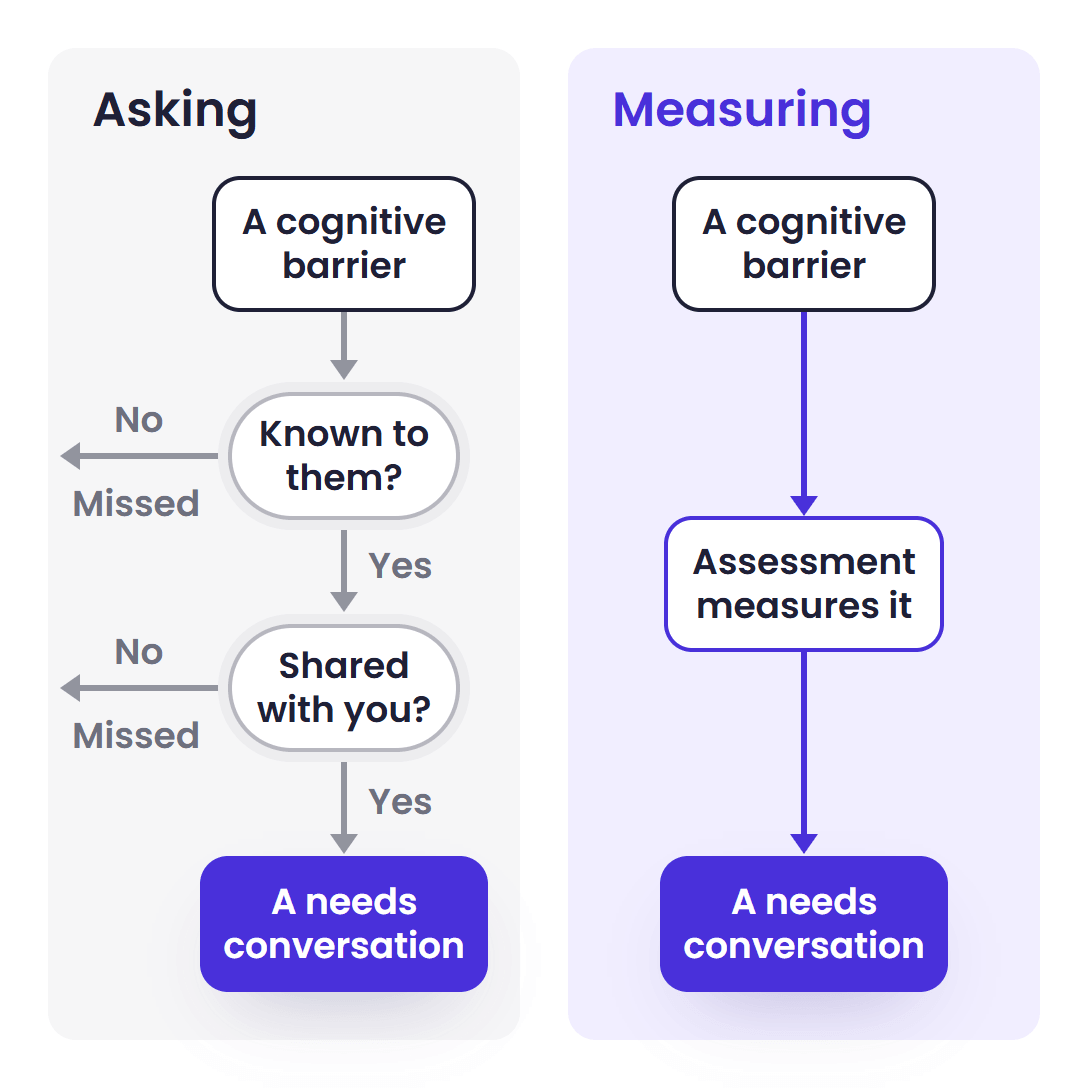
Asking is compliant. But it only finds the needs learners know about and choose to share.
Most providers identify learner needs by asking: an onboarding questionnaire, self-declaration, a self-report screening tool, or referral when someone visibly struggles. All are quick, and all are compliant. No rule requires a cognitive assessment. But each one depends on a learner knowing about a need and choosing to share it.
- Asking finds what learners know about and choose to tell you. Measuring finds needs that haven't been declared.
- Self-report records how learners see their own learning. A cognitive assessment measures how they actually process, remember and reason.
- A flag on its own is not a plan. A measurement should open a needs conversation and lead to support.
Case study · Aspiration Training
When self-report evidence didn't stand up, Aspiration Training started measuring
End-point assessment organisations pushed back on the evidence from Aspiration's self-report tool, and one rejected it outright. The real issue was validity. Aspiration replaced it with Cognassist's cognitive assessment, which measures how learners think rather than how they describe themselves.
“It feels like a perfect storm of timing. We've got a tool that supports inclusion from enrolment onwards, and the conversations we're having with coaches and learners about personalisation are happening every week now, not just when someone declares a need.”
- 20%more learners receiving personalised support, within two months
- Expected standardAspiration's Ofsted judgement across every area, May 2026
Assess
You can copy the screens. You can't copy the evidence behind the score.
Any assessment can look similar on screen. What matters is what stands behind the score. Find the need you're missing, accurately and at scale: the cognitive assessment measures cognition across nine domains instead of asking learners to describe themselves. Each strengths-first profile is a signal for a needs conversation and your staff's judgement, never a diagnosis.
- Normed on 26,301 UK apprentices, more than ten times the normative sample of the Wechsler Adult Intelligence Scale (WAIS-5)
- A Performance Validity Test on every domain guards the integrity of each result
- Independently validated as accurate and robust
Validated by PATOSS (the Professional Association of Teachers of Students with Specific Learning Difficulties) against the Joint Council for Qualifications' scientific-validity requirements
Plan
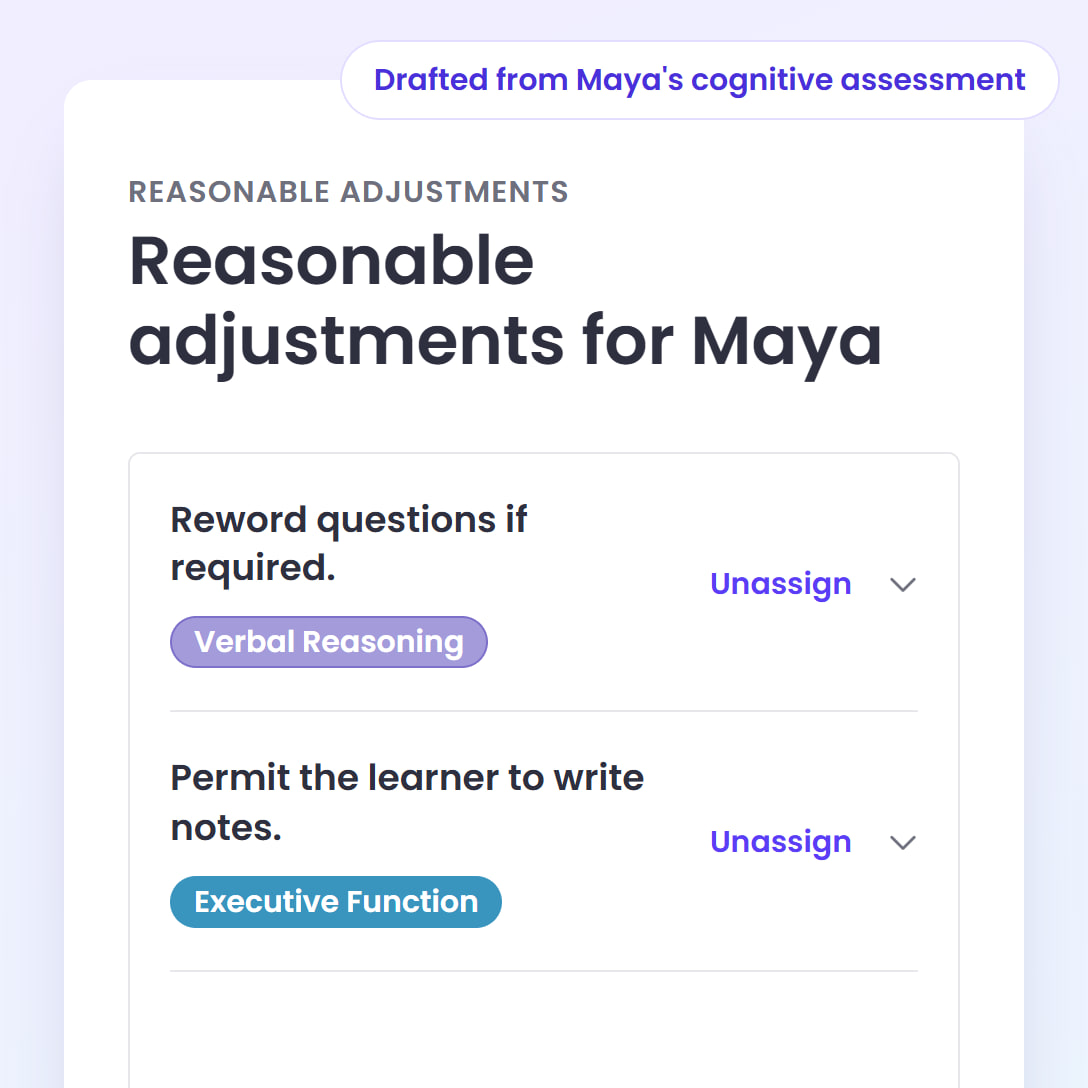
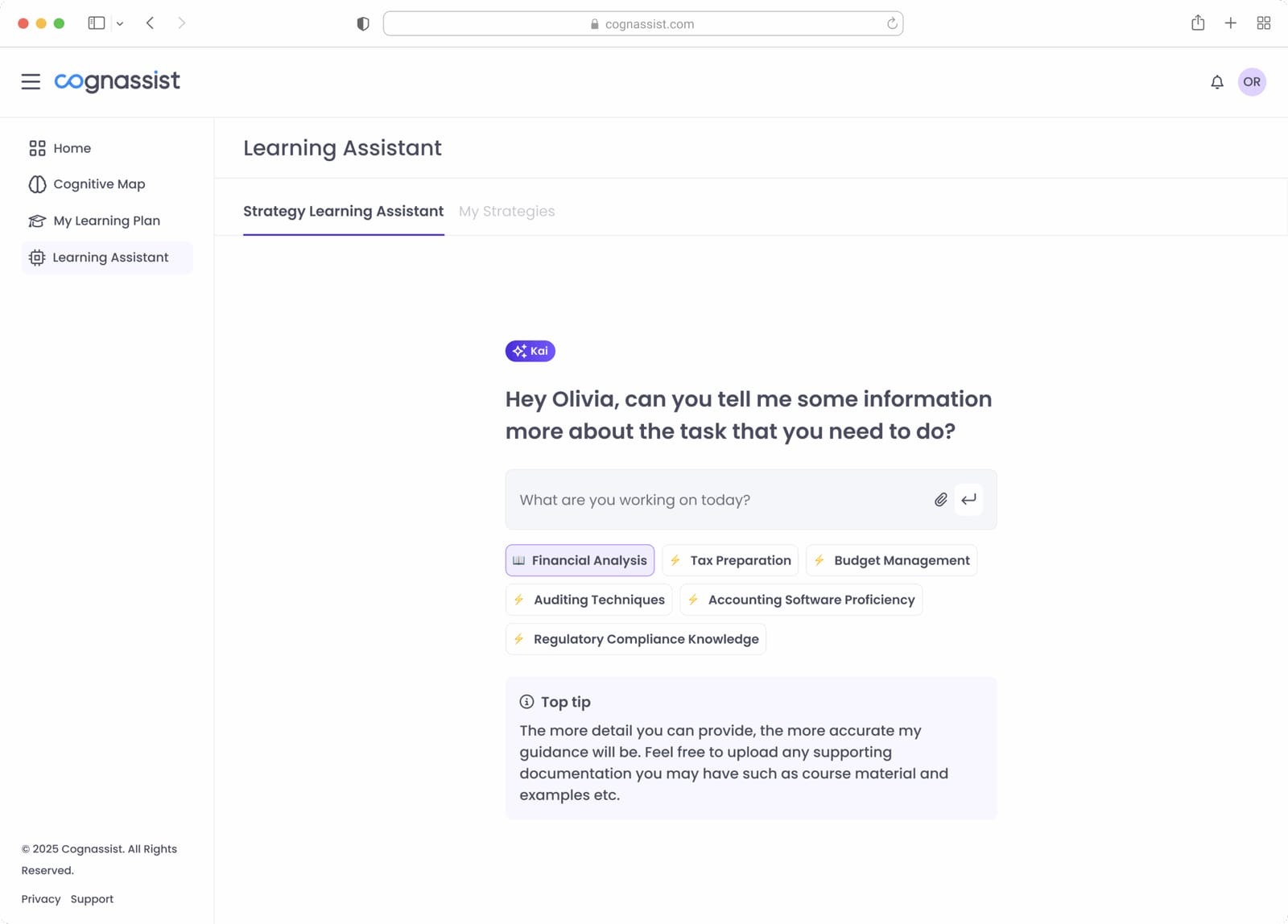
Where a barrier is found, a personalised support plan in approximately 10 minutes, ready for the tutor to tailor
When the assessment flags a barrier, the platform drafts a plan for that learner as a starting point. The tutor tailors it, then agrees it with the learner in a guided conversation, and the agreed plan is kept on record. Your staff make the judgement; the platform structures and records it.
- Matched reasonable adjustments are ranked, and the top three assigned
- Each adjustment is written as intent, implementation and impact, linked to the barrier it addresses
- Designed for non-specialists to deliver, so specialists can focus where they're needed most
The alternative was to increase our specialist resource fivefold. The trial gave us confidence that Cognassist can deliver what we need to empower our existing tutors to provide high-quality, personalised learning support at a scale that specialist teams alone could never reach.
Do and review
Support recorded as it's delivered, coached as it's written
Tutors record the adjustment they delivered and its impact, on the review cadence that suits your provision, monthly or quarterly. A coaching panel checks each record against intent, implementation and impact as it's written, so quality holds across tutors. Everyday practice stays separate from additional costed support, and any funding claim stays yours: good records are evidence of good practice.
- The whole plan is revisited at each periodic review: support continues, changes or ends, and stepping off support is evidenced
- Supported learners, coverage and costs export on demand, by CSV or API, for your own Individualised Learner Record return
- Works with your management information system or e-portfolio, never instead of it
Connects to the e-portfolio and apprenticeship systems your teams already use



Using something else? A public API connects your other systems. See how it connects to your systems
Beyond the plan
Support that carries on between sessions
Every assessed learner gets a learning assistant, available 24/7: those on a support plan between sessions, and those with no need identified. Inclusive tools should help everyone. It is shaped by each learner's cognitive profile, stays with them after they step off support, and aligns toward the Department for Education's safety expectations for generative AI in education.
- Administrators get real-time visibility across the provision, so leaders can show active oversight and act before a gap becomes a finding
- Staff get fourteen on-demand professional development courses, organised by role and stage
What our customers say
The trial has demonstrated that Cognassist has the ability to work effectively at an institutional scale, the results we've seen have given us the confidence to commit to a full rollout to every learner from September
By bringing Cognassist in, we were definitely able to identify a lot more learners and it highlights those additional needs that we wouldn’t have known...
It happens at induction for us… it starts the conversation about what would help, what do you think the barriers are, Cognassist is suggesting this, do you agree with that? Do you think this would help?
Seen enough to picture it in your provision?
Book a demo built around your learners, your current setup and where you want to get to. Or read how other providers made the change first.
Start from what you answer for
Senior leaders
You answer for inclusion across the whole provider. See how to make identification and support decisions you can defend.
Quality leads
You answer for what inspectors find. See how one approach across every cohort gives you evidence of practice, not paperwork.
SEND and learning support managers
Know who needs support, not only who tells you, with plans non-specialists write and learners agree.
Apprenticeship managers
Support decisions and records that stand up at audit and at gateway, across every cohort.
Tutors and assessors
Know how each learner processes information and what to adjust in the room, with plans drafted for you to tailor.
Tell us your role and your setup, and we'll build a demo around the questions you answer for.
Events
Join our next live session
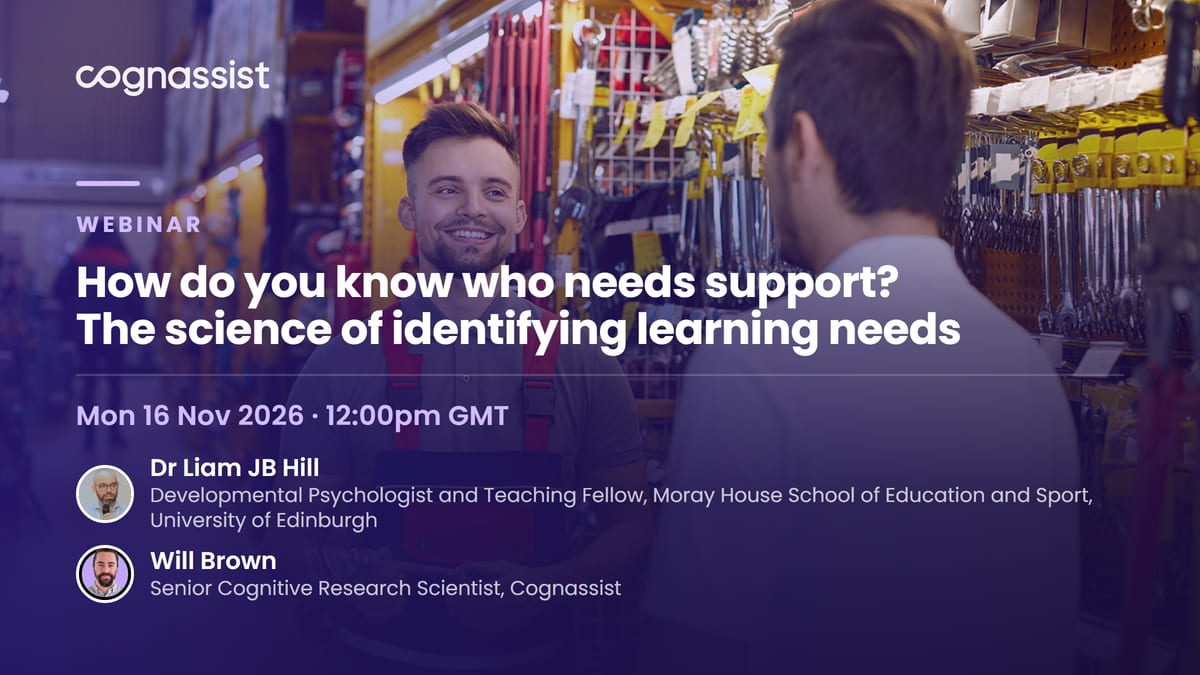
How do you know who needs support? The science of identifying learning needs
A 45-minute session for everyone involved in learning support, learning outcomes and inclusion: why self-declaration misses learners' needs, and what makes an assessment worth trusting.
Real results from real customers
The report is really useful and will definitely help assessors identify the support learners need. Having just completed my monthly ALS audit, I can already see how it could fill gaps in the quality of journals and reviews.”
The new Tutor Report simplifies what was previously complex and clearly shows what support to provide from day one of a learner’s programme. Well done, Cognassist.”
>80%
Achievement rates — University of Exeter
Read the case study
The new Cognassist AI function gives really helpful suggestions on how to improve your notes. The RAG rating makes it easy to see progress, and I now feel much more confident in what I’m writing — it’s more meaningful and intuitive.”
100%
Compliance in LSF claims — Brighter Horizons Training
Read the case study
The coverage checker provides clear guidance on language and structure. It’s been really valuable in ensuring our notes include the right level of detail and link back to the supporting evidence.”
95-100%
Engagement rate on the Cognassist platform — Train Together
Read the case study
Strong
Inclusion graded Strong standard by Ofsted, 2026 — Educationwise
Read the case study
3000+
Learners assessed — Key Training
Read the case study
Discussing reasonable adjustments through the Support Record is really beneficial as it helps explore how the adjustments are being applied in the workplace as well as in college. The AI checker is a helpful guide to ensure you’re heading in the right direction.”
Free resource
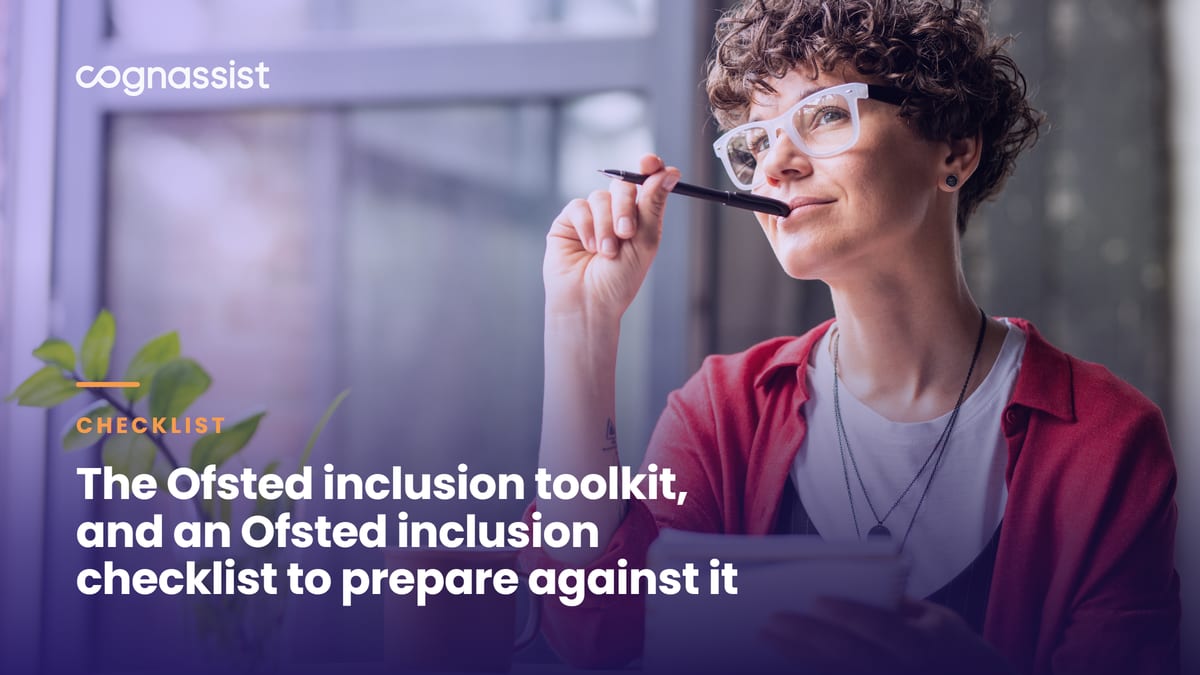
The Ofsted inclusion toolkit, and an Ofsted inclusion checklist to prepare against it
The Ofsted inclusion toolkit for FE and skills, explained: the grades, the planning call, case sampling, and a free Ofsted inclusion checklist for the 2026 toolkit.
Free guides to take back to your team
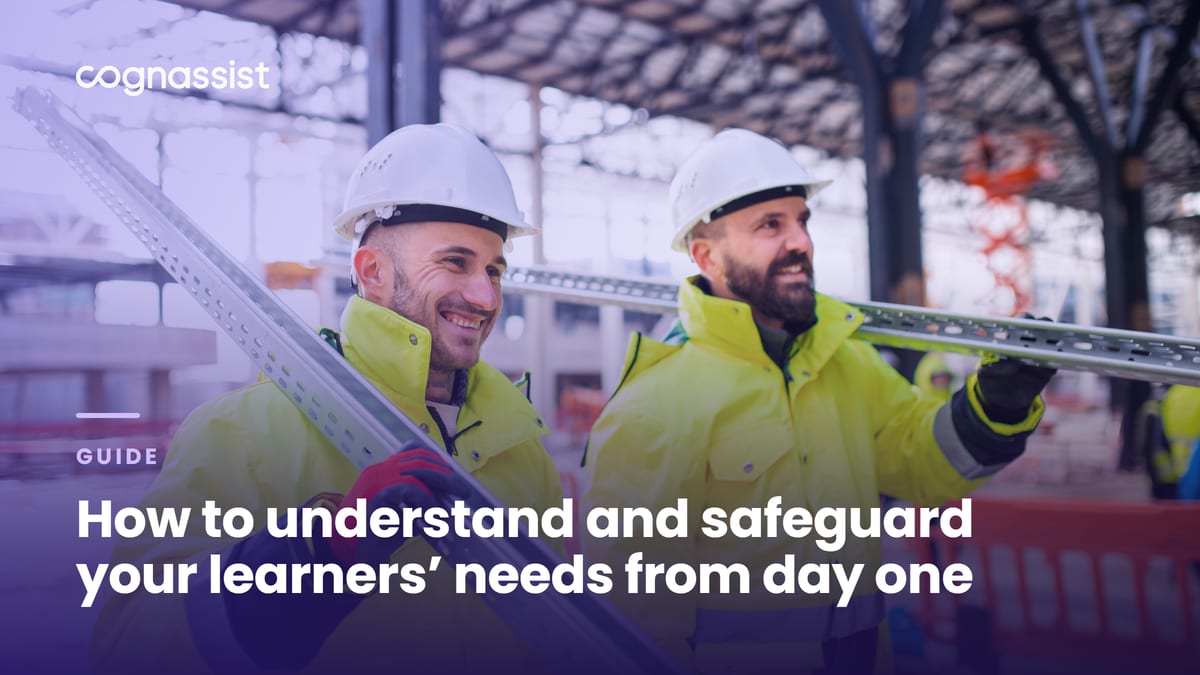
Free guide
How to understand and safeguard your learners’ needs from day one
Get the guide
Free checklist
Ofsted Inclusion Toolkit Checklist 2025
Get the checklist
Leadership paper
Inclusion 2.0: today, tomorrow and the day after
Read the paper
Webinar · On demand
Inclusion 2.0: rising demand, finite funding, no learner left behind
Watch now
Free template
Maximise Impact, minimise dropouts: The tutor’s adjustment playbook
Get the playbook
Free guide
How to support degree level apprentices
Get the guide
FAQ
Questions about identifying learner needs
What does Cognassist do?
Cognassist is the expert at identifying learners' needs and addressing them with personalised support plans. Our cognitive assessment measures how each learner thinks rather than relying on what they declare, and each need it finds starts the conversation that leads to a personalised plan the learner agrees. Support is then recorded as it's delivered. We have supported learners across further education, apprenticeships and adult skills since 2017.How do colleges and training providers identify learners' support needs?
Most ask: an onboarding questionnaire, self-declaration, a self-report screening tool, or referral when a learner visibly struggles. That is compliant, but it depends on learners knowing about a need and choosing to share it. Around 1 in 3 learners across FE and apprenticeships may have a cognitive barrier that warrants support, and some may have one that self-declaration misses; in 2024/25, 16.7% of apprenticeship starts and 20.3% of adult FE and skills learners declared a learning difficulty or disability. A cognitive assessment adds a measurement that starts the needs conversation.What is a learner needs assessment in further education?
It is how a provider finds out what support a learner needs, usually at the start of their programme. Inspectors explore how staff identify learners who need support, but no rule fixes the method. A cognitive assessment can be one robust part of it, alongside a conversation with the learner and any known barriers or diagnoses, never the whole of it.Is a cognitive assessment a diagnosis?
No. Cognassist measures cognition and never diagnoses. A cognitive profile is a signal for a needs conversation and professional judgement, and one method within an evidence-based assessment that includes a human conversation. It is never the only basis for eligibility.Is the Cognassist cognitive assessment validated?
Yes. It is independently validated as accurate and robust, and validated by PATOSS against the Joint Council for Qualifications' scientific-validity requirements. It is normed on 26,301 UK apprentices, more than ten times the WAIS-5 normative sample, with a Performance Validity Test on every domain and three strands of validation evidence published. Internal consistency reaches .91 and .93 on the Language & Numbers and Visual & Fluid indexes.How is a cognitive assessment different from a self-report screening tool?
A screen is quick, and it is compliant. The difference is what stands behind the result: a self-report tool records how learners describe themselves, while the cognitive assessment measures cognition against a norm of 26,301 UK apprentices, with a validity check on every result. And the result never sits as a flag on its own: it feeds an agreed personalised support plan and a recorded evidence trail. Ask the same diligence questions of any assessment, including ours.Does Ofsted require a cognitive assessment?
No. No rule requires a cognitive assessment, and Ofsted endorses no product. Under the renewed inspection framework, in use since November 2025, inclusion is graded as its own evaluation area, and inspectors explore how staff identify learners who need support. The method is yours to choose.How do you create personalised support plans for learners?
The platform drafts a personalised support plan from the assessment in around 10 minutes, as a starting point for the tutor to tailor. Matched reasonable adjustments are ranked and the top three assigned, each written as intent, implementation and impact. The tutor then agrees the plan with the learner in a guided conversation, and the agreement is kept on record.If we find more need, can our team support it?
Yes, through the graduated approach. Most needs are met by everyday adjustments your tutors deliver, specialists go where they're needed most, and the plan is revisited at each periodic review, with learners stepping off support when they're ready. Cognassist does not replace your learning support team: it extends its reach.What learning support software do apprenticeship providers use?
Cognassist is learning support software for apprenticeship providers, colleges and universities: it identifies needs, drafts personalised support plans and records support as it is delivered. It works with your management information system or e-portfolio, never instead of it, through partner-built connectors for OneFile, Bud, Aptem and OneAdvanced ePortfolio, plus a public API. Exactly how it fits your setup is mapped on a technical call.Can we claim learning support funding for the support we record?
Good records are evidence of good practice, and the claim is always your own. Under the Department for Education's apprenticeship funding rules for 2026 to 2027, learning support funding is £150 per supported learner per month, claimable only in months when adjustments are needed, delivered, evidenced and cost money, and are additional to everyday teaching. No diagnosis is required.

Bring us your learners, your setup and your goals
We'll build your demo around them, and show you how to find the needs you're missing and meet each one with a personalised plan.